
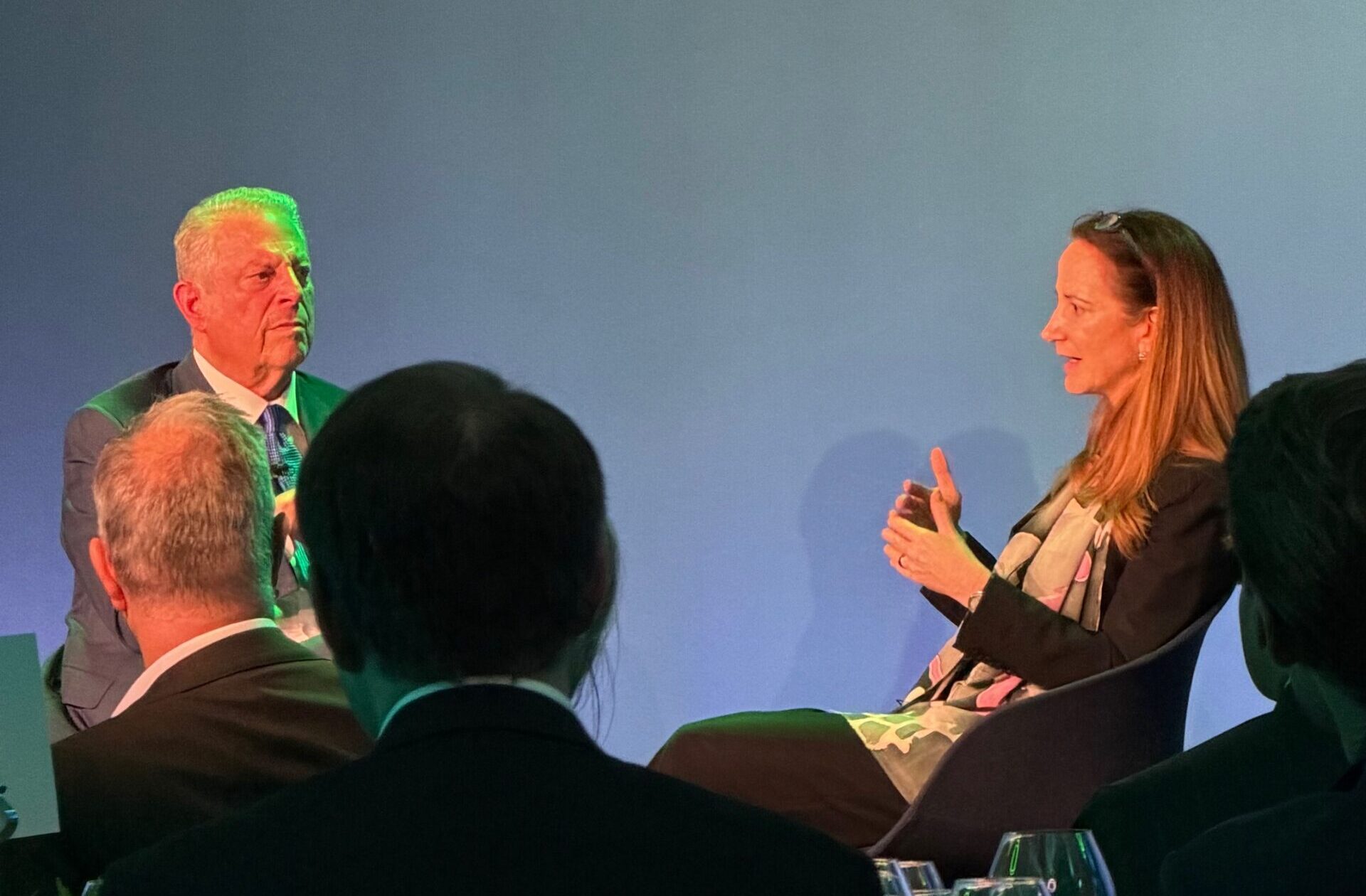
This week, at the Generation & Just Climate’s Global Client Conference 2026, the air was thick with a level of gravity that only a Nobel Laureate and a former Director of National Intelligence can command. Al Gore and Avril Haines sat down for a fireside chat that felt less like a briefing and more like a map of the world’s most dangerous fault lines.
For investors, the session was a stark reminder that the energy transition is no longer a sub-sector of ESG. It is the primary engine of national security and economic survival.
The Fertilizer Chokepoint: A Global Food Crisis in the Making
We often talk about the Strait of Hormuz through the lens of oil—roiughly 20% of global supply passes through that narrow neck of water. But Gore and Haines pulled back the curtain on a much scarier statistic: food resilience.
One-third of all seaborne fertiliser supply—including nearly 50% of global urea and 30% of global ammonia—transits through the Straits with the region being a major producer of both key ingredients, commonly used in nitrogen-based fertilisers. We aren’t just looking at an energy crunch; we are looking at a potential collapse of global crop yields.
Add to this the regional dependence on the Straits of Hormuz for food imports into the Middle East. 85% of all food consumed in GCC countries is imported and 70% of all food imports pass through the strait, making the population highly dependent on open trade. Saudi Arabia has four months of wheat supply left, and with vessel traffic down 90% since the start of US and Israel’s attacks on Iran, a humanitarian crisis could be not far off.
The “Venezuela Trap” and the Iran Miscalculation
The geopolitical analysis was cutting. Gore and Haines suggested that the Trump administration may have badly miscalculated the situation in Iran, emboldened by the perceived ease of actions in Venezuela. But as Haines noted, Iran is a different beast entirely.
The only believable strategic objectives—regime change and the removal of enriched uranium—are not just complex; they are arguably impossible to achieve without a catastrophic regional escalation.
Meanwhile, Europe sits in a precarious position. The EU rightfully fears being dragged into a conflict with no clear exit, one that could reignite regional extremism just as they have stabilized their own borders. Extreme water scarcity in Tehran – already a known factor in driving political instability – is likely to exacerbate an inevitable migration crisis that will result from the Iran conflict.
The Russia-Ukraine-China Nexus
While the Middle East burns, Russia is on the back foot. Despite a temporary runway provided by spiked oil prices – estimated around $150m in extra oil revenue per day at current prices – the Russian economy is teetering. The loss of life for Russia has been staggering—far surpassing Ukraine’s own losses—and the EU’s continued support is yielding surprising progress on the ground.
However, the ripple effects don’t stop at the Ural Mountains. The consensus was clear: the instability in Iran has likely accelerated China’s timeline for Taiwan, which could infinitely magnify global volatility and disruption.
For China—and for Europe—this volatility has removed the last remnants of choice regarding the energy transition. Energy independence is now a matter of national survival.
The Invisible Casualty: The Environmental Debt
Yet there is one element in the analysis of the conflict with Iran that is regularly missing from the discussion: that of the vast and lasting environmental and ecological damage that is unfolding as a direct result of infrastructure destruction. We are seeing massive releases of toxic gases and carbon spikes that dwarf the annual emissions of small nations.
Infrastructure damage and toxic releases are poisoning land and water supplies in a region already defined by extreme food and water scarcity and insecurity. When we talk about reconstruction costs later, we aren’t just talking about bricks and mortar—we’re talking about the permanent loss of natural ecosystems and the long-term health challenges of the populations living there.
Should Iran start targeting water-desalination plants across the Gulf, the primary source of drinking water for millions of people living in the Gulf would be jeopardised. This already happened in Bahrain, and Iran claims a plant was struck, affecting water supply to 30 villages.
The Investor’s Mandate for 2026
So, where does this leave us? As ethical investors, we cannot afford to be passive observers of these macro trends.
The reality is this the old world of fossil-fuel-led security is dead. It is too volatile, too concentrated, and too prone to the threat multipliers of war, supply shocks, and of course climate change.
The path forward for capital is clear:
- Accelerate Clean Tech: Localised energy production is a national security imperative, and crucial to the future prosperity of nations and the health of our economies.
- Build Food & Water Resilience: Water desalination, soil health, and local food security (e.g. through alternative proteins, aquaculture, etc) are even more necessary in a world in conflict.
- Decouple from Chokepoints: Diversify supply chains away from geostrategic bottlenecks.
We are navigating a crisis where there are no easy paths out. Lifting sanctions on Russian oil or betting on a quick victory in Iran is a gambler’s move, not an investor’s strategy.
For the disciplined investor, these short-term shocks are the ultimate proof of the old system’s fragility. They are the friction points of a global economy trying to shed its reliance on concentrated, volatile commodities. Preparing for volatility doesn’t mean moving to the sidelines; it means building a portfolio that is anti-fragile—one that finds alpha in the very transitions these crises are accelerating.
Looking past the immediate horizon, the structural drivers of the next decade are undeniable and accelerating. We are now entering an AI-driven energy supercycle, where the voracious demand for compute is colliding head-on with the non-negotiable mandate for a total renewable transition. The clearest win today lies in energy independence, resource resilience, and the relentless pursuit of a low-carbon future that removes the oil-for-security leverage from the global board.
Yet we need more than just a fuel swap; we need a fundamental move toward a regenerative economic model that treats ecosystem restoration and natural resources as the bedrock of value.
The crisis in the Strait of Hormuz is a tragedy, but it is also a loud, clear signal: the future belongs to those who build for resilience, make long-term bets, and help rewire capitalism for a more sustainable, regenerative future.
Comments are closed.

