
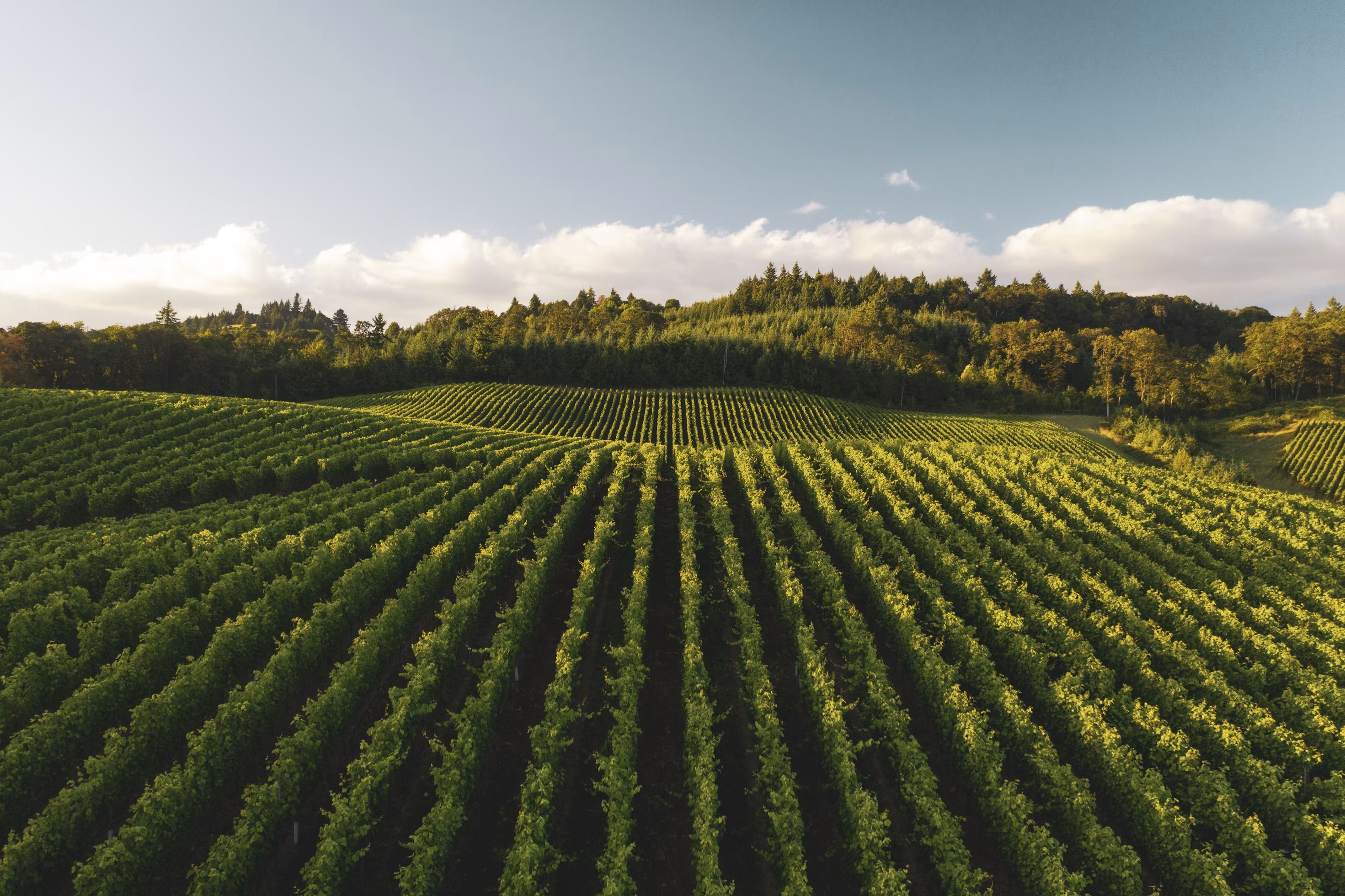
When Professor Andrew Balmford FRS delivered this year’s Royal Society Environment Prize Lecture — “Feeding the world without costing the earth” — he posed a question that sits at the heart of food systems investing: how do we meet humanity’s most basic need without dismantling the natural systems that it depends on? [1] As Professor of Conservation Science at Cambridge’s Department of Zoology, Balmford has spent his career building the evidence base to answer it, working across economics, psychology and ecology, and arguing in his book Wild Hope that cautious, evidence-based optimism is essential to environmental progress. [2] For those of us deploying capital toward a sustainable food future, his findings are both a caution and a roadmap.
A system undermining itself
Before exploring the bad news, Professor Balmford acknowledged the incredible human achievement resulting from modern farming: since 1961, global food supply has grown roughly 30% faster than population. [3] Humanity is, in aggregate, better fed than ever before. But the planet has paid dearly. Food production is a major driver of biodiversity loss — the foundation of healthy, functioning ecosystems — and the latest Living Planet Report records a 73% average decline in monitored wildlife populations between 1970 and 2020. [4] Our food system also accounts for somewhere between a quarter and a third of global greenhouse gas emissions, making it one of the largest contributors to the climate emergency. [5]
The cruel irony is that food production depends on the very stability it erodes: reliable rainfall, predictable temperatures, intact soils. In other words, our food system is busy undermining itself. Balmford captured the stakes with a line from the food-security expert Sir Charles Godfray: “If we fail on food, we fail on everything.” [6]
The land question
Land is the binding constraint. Work presented in the lecture on cropland demand — including research by Dr Yi Gong — maps agriculture’s footprint against hard biophysical limits, showing how close we are to breaching a safe operating space for land-system change. Analysis of the land needed to grow conventional livestock feed points to a powerful lever: low-opportunity-cost feeds. Substituting soy- or grain-based feed proteins with insect or microbial proteins could spare millions of hectares of arable land — land that could be repurposed for biodiversity or as carbon stores.
A 2018 study in Environmental Science & Technology puts hard numbers on that opportunity. Modelling industrial microbial protein — bacteria, yeast, fungi or algae grown in fermenters rather than fields — the researchers found it could supply between 10% and 19% of crop-based animal-feed protein demand by 2050. That single substitution could shrink global cropland area by around 6%, cut nitrogen losses from croplands by roughly 8%, and lower agricultural greenhouse gas emissions by about 7%. [7] Most striking for investors is the authors’ conclusion that the technology to produce microbial protein at competitive cost is already accessible for deployment, with the potential to drive a major structural shift in the agro-food system — making it a near-term opportunity rather than a distant moonshot.
A clear negative example is biofuels. By diverting cropland to fuel, they push grain prices up — one analysis of the US Renewable Fuel Standard found corn prices roughly 30% higher and crops such as soybean and wheat around 20% higher — while proving, once land-use change is counted, at least as carbon-intensive as the fossil fuels they replace. [8] On both ethical and climate grounds, the case against them is straightforward.
Shifting demand within planetary boundaries
Supply is only half the equation. The EAT–Lancet framework sets out what eating within planetary boundaries looks like, and behavioural policy can move us toward it. [9] London’s restrictions on advertising foods high in fat, salt and sugar (HFSS) across the Transport for London network were associated with a 6.7% fall in the calories households purchased from products high in those components. [10] Amsterdam has applied the same logic to meat advertising, becoming the first capital city to ban it in public spaces (effective May 2026), following the Dutch city of Haarlem — an experiment worth watching closely. [11] Crucially, research shows that simply making good vegetarian options available and visible is itself a major driver of dietary change. Quality and availability, not just willpower, shift diets — and shifting diets is critical to restoring planetary boundaries.
Why yields decide the outcome
Balmford presented scenarios for global cropland change from 2010 to 2050, testing high- and low-yield pathways against varying success on SDG 12 targets for food loss and waste. [12] The sobering conclusion: even in a realistic best case — halfway to EAT–Lancet dietary shifts and halfway to waste-reduction goals — every scenario still results in more land lost to farming.
Supply-side gains change the picture dramatically. A 25% yield increase makes the land-use outlook mostly positive; a 50% gain actually reduces farmland across all scenarios. Yield, in short, is where the leverage is.
Sparing, not sharing
This leads to the core of Balmford’s research: the choice between land sharing and land sparing. Land sharing integrates food production and conservation on the same fields, using wildlife-friendly, low-yield, organic or agroforestry practices so wild species can live alongside crops. Land sparing separates high-yield, intensive agriculture on the smallest possible footprint from strictly protected wild habitat, leaving the land not needed for farming entirely intact.
Across a review of more than 2,500 individually assessed plant, insect and vertebrate species from five continents, land sparing consistently comes out ahead. [13] Most wild species are highly specialised and cannot survive the conversion of their native habitat — even on benign “wildlife-friendly” farms, small changes can be enough to push them out, causing irreversible damage. By maximising yield per acre, we need fewer acres overall, leaving more undisturbed space for threatened, restricted-range species.
Balmford set three requirements for any credible impact assessment of food-system change — a useful due-diligence checklist for investors: measure biodiversity as abundance rather than through narrow proxies; consider all possible land uses; and account for off-site effects, including the negative externalities of pushing land conversion elsewhere when local yields change.
A managed transition, not a cliff edge
Sri Lanka is the cautionary tale. In 2021 its abrupt ban on fertiliser imports cut rice harvests by roughly a third, turning a country long self-sufficient in rice into an importer and feeding into a wider crisis that saw mass protests, the fall of the government and national bankruptcy. [14] The lesson is not that fertilisers and herbicides are benign — they are damaging — but that scaling up sustainable, high-yield systems to replace them must be a managed transition, not a sudden shock.
So the goal is not biodiversity-friendly farming for its own sake, but sustainable ways of raising yields. Balmford pointed to a promising toolkit — and an investable pipeline: new genetic techniques such as drought-resistant crops (we should stay open-minded about every option); silvopasture; push–pull systems that use companion planting for natural pest control, as pioneered across sub-Saharan Africa; precision farming focused on smallholders growing staple crops; and integrated soil-crop system management. An incredible Chinese programme that lasted over a decade, involving tailored, site-specific recommendations (advising on planting times, crop varieties, and fertiliser amounts) and delivered to 21 million farmers across 452 counties, lifted yields by around 11% while cutting fertiliser use by roughly a sixth. Input savings and yield increases delivered an estimated $12.2 billion in total economic benefits, on top of significant greenhouse gas savings and nitrogen runoff reductions. [15]
Markets alone won’t do it
Here is the warning impact investors most need to hear. Higher yields can pollute — heavy fertiliser and pesticide use can foul air and rivers badly enough to cancel out the benefits of sparing habitat, so pollution-minimising policy and practice are essential. And efficiency triggers the rebound effect, or Jevons Paradox: when the economist William Stanley Jevons observed in 1865 that more efficient engines increased rather than reduced coal use, he identified a trap that haunts food systems too. [16] Higher yields can lower prices, spurring more consumption, more waste and more habitat conversion — and can even raise the cost of conservation by making each field more profitable to farm.
Market signals alone, therefore, cannot restore biodiversity or carbon sinks. They must be paired with strong policy that protects spared land. Regulated, market-based incentives work: Costa Rica halved its clearance of mature forest by zoning it off-limits and shifting export production toward high-yielding pineapple and banana crops; Himalayan herders are paid to set aside pasture for wild sheep — prey for snow leopards — and insured against livestock loss, ending retaliatory killing of the cats; and Brazil’s combination of protected-area zoning, forest conservation on private land and yield subsidies on degraded pasture has driven Amazon deforestation sharply down since 2004. [17]
The takeaway
Balmford’s conclusion is one sustainable food investors should internalise: slowing biodiversity loss will hinge on promoting and regulating sustainable, high-yield farming, and linking it explicitly to habitat conservation. Capital that backs yield-enhancing innovation, alternative proteins and managed transitions — and that treats supportive policy as a feature rather than a bug — is the systemic capital required to feed the world without costing the earth. With a growing focus on sustainable high-yield food systems, new innovation using robotics, AI, genetics and more, new food policies, and food supply chain resilience, the opportunity for impact investors in this space has never been greater.
Sources and further reading
- Royal Society Environment Prize Lecture, “Feeding the world without costing the earth,” Professor Andrew Balmford FRS, Royal Society, 16 June 2026. https://www.interacademies.org/news/royal-society-environment-prize-lecture-explore-sustainable-food-production-and-biodiversity
- Andrew Balmford, Wild Hope: On the Frontlines of Conservation Success (University of Chicago Press, 2012). https://press.uchicago.edu/ucp/books/book/chicago/W/bo13391607.html
- Global food supply has outpaced population growth since the 1960s. FAO data; see Our World in Data, Food Supply. https://ourworldindata.org/food-supply
- WWF & Zoological Society of London, Living Planet Report 2024 — a 73% average decline in monitored wildlife populations, 1970–2020. https://www.worldwildlife.org/publications/2024-living-planet-report
- Estimates of the food system’s share of global greenhouse gas emissions range from ~26% (Poore & Nemecek) to ~34% (Crippa et al., 2021, Nature Food). Our World in Data, Environmental Impacts of Food Production. https://ourworldindata.org/food-ghg-emissions
- Sir Charles Godfray (Director, Oxford Martin Programme on the Future of Food), “If we fail on food, we fail on everything.” University of Southampton. https://hartleynews.soton.ac.uk/2017/10/09/facing-the-challenge-on-food-security
- Pikaar, Sharma, Bodirsky, Weindl et al. (2018), Decoupling Livestock from Land Use through Industrial Feed Production Pathways, Environmental Science & Technology 52(13): 7351–7359. https://pubs.acs.org/doi/10.1021/acs.est.8b00216
- Biofuels, food prices and carbon intensity — analysis of the US Renewable Fuel Standard (Lark et al., 2022, PNAS), reported via Grist. https://grist.org/food-and-agriculture/cop30s-biofuel-gamble-could-cost-the-global-food-supply-and-the-planet/
- Willett et al. (2019), Food in the Anthropocene: the EAT–Lancet Commission on healthy diets from sustainable food systems, The Lancet. https://eatforum.org/eat-lancet-commission/
- Yau et al. (2022), PLOS Medicine — Transport for London’s HFSS advertising restrictions linked to a 6.7% reduction in calories purchased from HFSS products. London School of Hygiene & Tropical Medicine. https://www.lshtm.ac.uk/newsevents/news/2022/transport-londons-junk-food-advertising-restrictions-linked-reductions-high
- Amsterdam becomes the first capital city to ban meat advertising in public spaces (effective 1 May 2026); Haarlem was the first city, in 2022. Euronews. https://www.euronews.com/2026/02/06/amsterdam-to-enact-landmark-ban-on-fossil-fuel-and-meat-advertising-in-public-spaces
- Foundational land-sparing research: Phalan, Onial, Balmford & Green (2011), Reconciling food production and biodiversity conservation: land sharing and land sparing compared, Science 333: 1289–1291. https://www.science.org/doi/10.1126/science.1208742
- Balmford (2021) review across 2,500+ species, summarised by the University of Cambridge, Concentrate farming to leave room for species and carbon. https://www.cam.ac.uk/stories/landsparing
- Sri Lanka’s 2021 fertiliser import ban and its aftermath. International Water Management Institute. https://www.iwmi.org/blogs/challenges-and-opportunities-for-an-agro-ecological-transformation/ (see also Foreign Policy, March 2022: https://foreignpolicy.com/2022/03/05/sri-lanka-organic-farming-crisis/)
- Primary source for the China integrated soil–crop system management results: Cui, Zhang, Chen et al. (2018), Pursuing sustainable productivity with millions of smallholder farmers, Nature 555: 363–366. https://www.nature.com/articles/nature25785
- Jevons Paradox / the rebound effect — W. S. Jevons, The Coal Question (1865). https://en.wikipedia.org/wiki/Jevons_paradox
- Yield-raising options (incl. integrated soil-crop system management in China and the push–pull system), the pollution caveat, and the Costa Rica, Himalayan snow-leopard and Brazilian Amazon policy examples. University of Cambridge, How “more food per field” could help save our wild spaces. https://www.cam.ac.uk/research/news/how-more-food-per-field-could-help-save-our-wild-spaces
Comments are closed.

