
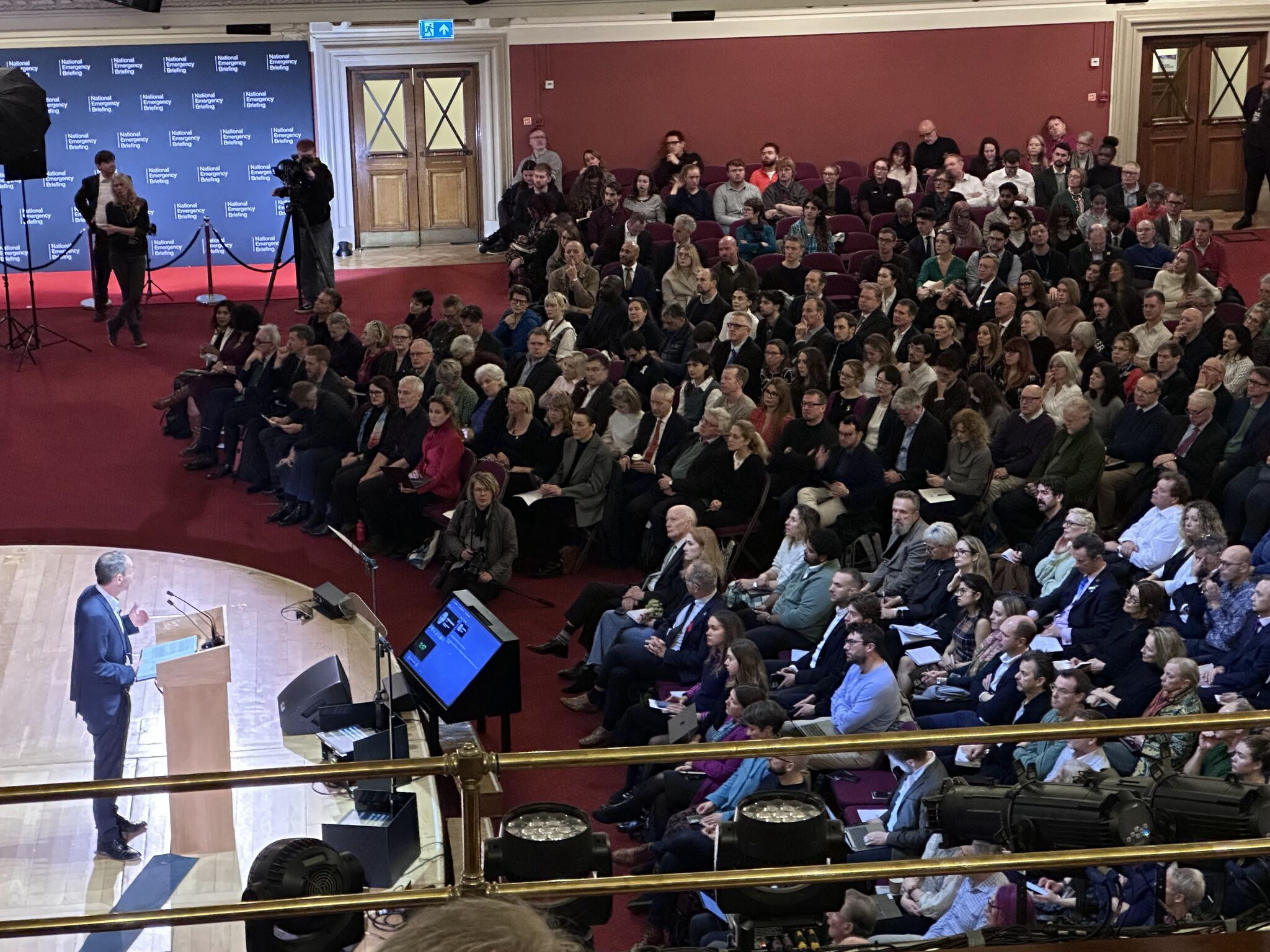
Leadership on climate and nature must now match the urgency and scale of a world war effort, because our safety, prosperity and democratic stability genuinely depend on it.
The National Emergency Briefing in Westminster on 27th November 2025 brought this reality into sharp focus, making clear that the choice is no longer between action and inaction, but between national resilience and escalating crisis.
A call for WWII‑level leadership
Chris Peckham CBE and Professor Mike Berners‑Lee opened and chaired the briefing, urging political and civic leaders to adopt “World War II level leadership” in response to the climate and nature emergency, emphasising that the situation demands the same clarity of purpose, mobilisation of resources and moral courage that characterised wartime decision‑making.
This is not rhetoric for effect: the evidence presented by ten leading experts and scientists, showed that climate and ecological breakdown are already destabilising core systems that our modern societies rely on, from food supply to national security and financial stability.
The failure of recent international negotiations, such as COP30, to secure a decisive shift away from fossil fuels underlines why national governments and citizens cannot wait for perfect global consensus before acting. While fossil fuel interests continue to dilute international agreements, the briefing stressed that individual countries still have both the power and the responsibility to accelerate their own transitions, reaping social and economic benefits in the process.
The emergency we face
Ten leading scientists and experts from across the UK outlined how climate change and nature loss now constitute a multi‑dimensional emergency, affecting the economy, health, food systems and national security simultaneously.
Professor Kevin Anderson highlighted that global temperatures are on track for 3–4°C of warming by the end of the century under current trajectories, far beyond levels considered compatible with stable societies and functioning ecosystems.
The risks are not abstract. Analyses presented by Professor Hugh Montgomery showed that unchecked warming could erode global GDP dramatically over the coming decades, with some modelling suggesting very large losses in output by late century under high‑emissions scenarios. The Institute and Faculty of Actuaries have warned that warming of around 3°C or more could trigger state failures, large‑scale displacement and billions of premature deaths, as heat, crop failures, conflict and disease interact in destabilising ways. These risks are currently being underpriced by insurers and investors.
Why rapid action boosts prosperity
One of the strongest messages from the event was that advancing faster on climate and nature action is economically advantageous, not a drag on growth. Investments in clean energy, building retrofits, public transport, nature restoration and resilient infrastructure create jobs, spur innovation and reduce structural costs across the economy, from energy bills to healthcare expenditure. Furthermore, as Angela Francis shared, the costs of funding the transition (or the investment required, since it generates a return), is 73% lower than we thought it would be just five years ago.
Recent international analyses, including work by organisations such as the OECD, suggest that enhanced climate action results in higher global GDP over time compared with business‑as‑usual or “unclear” policy paths, which undermine investment certainty and increase climate damage costs. The briefing underscored that delaying action compounds risk: slow, hesitant transitions lock in obsolete assets and higher future losses, whereas decisive moves now generate roughly double the economic benefits compared with a drawn‑out response.
Food systems and national security
The experts repeatedly returned to food security and national security as central reasons to treat climate and nature as an emergency rather than a distant environmental issue.
Professor Paul Behrens shared that climate impacts such as heatwaves, droughts and floods are already disrupting crop yields and supply chains, while the degradation of soils, water systems and biodiversity weakens the resilience of agriculture to shocks.
Lt Gen Richard Nugee CB CVO CBE described climate change as a “threat multiplier,” amplifying existing geopolitical tensions, driving migration and increasing the likelihood of conflict over resources. When food prices spike or supplies falter, social unrest can emerge rapidly, echoing the warning that “there are only nine meals between mankind and anarchy” and reminding policymakers that robust food systems and a stable climate are prerequisites for a healthy democracy.
Health, communities and everyday life
The climate and nature crisis is also a public health emergency. Professor Hugh Montgomery OBE warned that rising temperatures, air pollution, extreme weather and shifting disease patterns are already harming physical health, while ecological decline and climate anxiety weigh on mental wellbeing. However, many of the measures needed to cut emissions and restore nature simultaneously improve health outcomes.
Designing cities and towns around clean transport, green spaces and energy‑efficient buildings encourages active lifestyles, reduces respiratory illness and strengthens community connection. A shift towards healthier, more sustainable diets and resilient local food systems can lower rates of diet‑related disease while reducing pressure on land and ecosystems. In short, acting decisively on climate and nature is also an investment in a healthier, more cohesive society.
From warning to action
The National Emergency Briefing was not only a warning; it was a roadmap for how to move forward at the necessary pace and scale. Experts called for clear, science‑based national plans, serious public communication, and policies that align finance, regulation and infrastructure with a rapid transition away from fossil fuels and ecosystem destruction.
Citizens have a right to understand the seriousness of the emergency, as well as the opportunities available from rapid and bold investment. That’s why the National Emergency Briefing was also calling for a televised national emergency briefing and a sustained public engagement campaign, urging political leaders and media organisations to present the facts transparently and clearly outline the choices ahead to the public. By helping to reset the national conversation in this way, people can press for the WWII‑level leadership that this moment demands, and open the door to a safer, more prosperous future built on climate stability and thriving nature.
To learn more about the event, and to sign the letter to Kier Starmer and media leaders, visit https://www.nebriefing.org
Comments are closed.

