
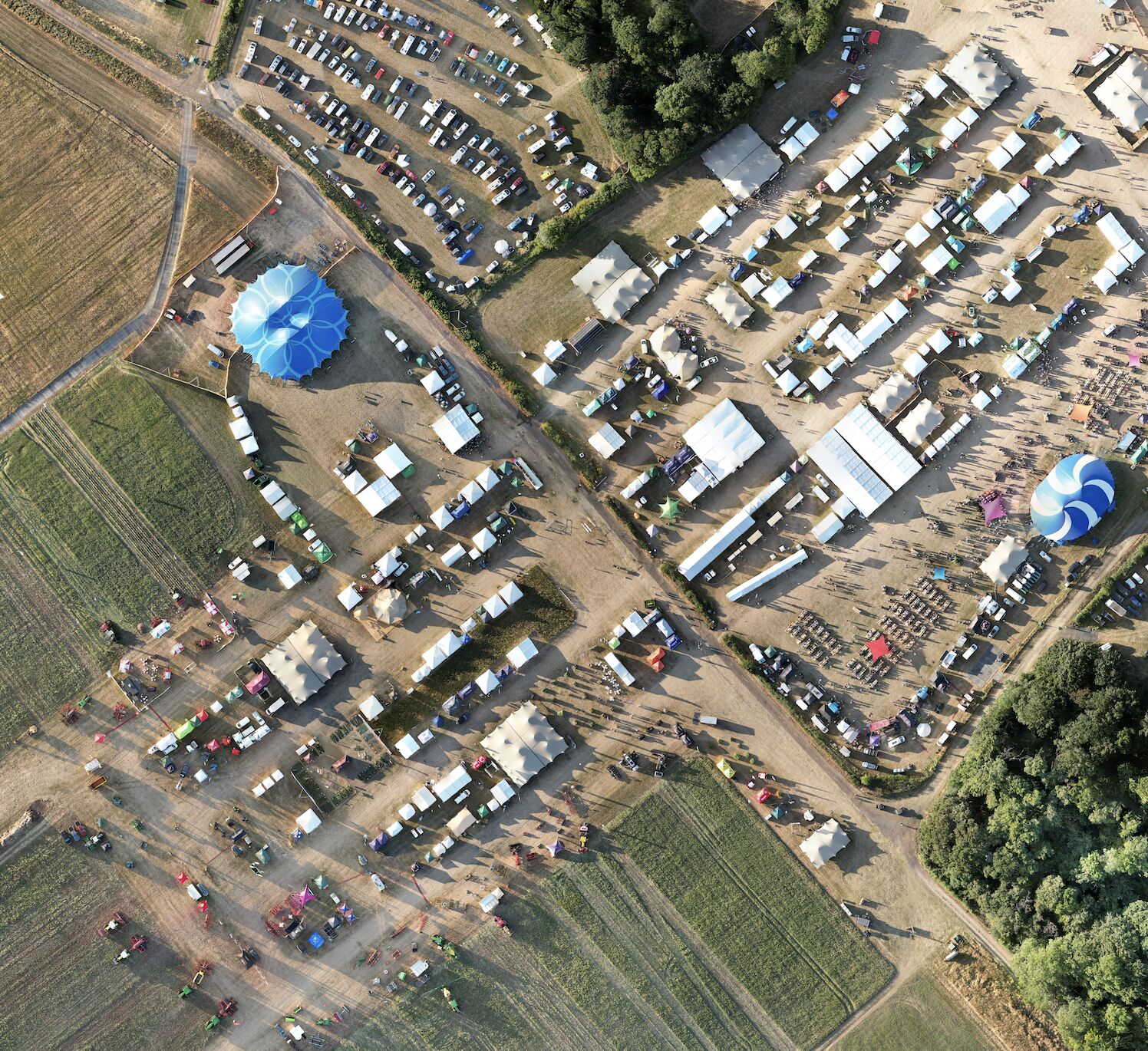
Ten thousand people. Ten years running. This year’s Groundswell, held at Lannock Farm just north of London, was unmistakable: a decade in, the movement feels stronger than it has ever been. There was real confidence, built on a decade’s worth of accumulating evidence that regenerative practices work — agronomically, commercially, and ecologically.
That confidence has been sharpened this year by a harder edge of urgency, arriving from two directions at once. The UK has just experienced its hottest, driest, and second-wettest growing seasons all within the past five years — a whiplash of extremes that leaves little room to argue the climate impacts aren’t already here. And Groundswell itself convened only a week after one of Europe’s worst heatwaves on record, a stretch of extreme heat under which conventional chemical farming systems are visibly and increasingly stressed. Layered on top of that is the closure of the Strait of Hormuz and the resulting shock to global energy and supply chains, which has made “resilience” feel less like a buzzword and more like an immediate, practical necessity for anyone thinking about where food comes from.
Together, these shocks are making the case for more resilient farming systems — the kind regenerative agriculture is built to offer — harder to dismiss than ever. Alongside that was a cautious optimism that the movement is finally gaining ground with mainstream farmers, big food companies, and policymakers who a few years ago might have dismissed regenerative agriculture as fringe.
As always, it was hugely inspiring to hear such a wide range of views, to hear directly from farmers themselves, and to take in wide-ranging discussions and global voices all focused on the same question: how do we keep pushing this shift toward regenerative agriculture forward, worldwide.
Underneath that mood, the numbers also tell a story of real but early progress. The demand signal is strong: 80% of UK farmers surveyed for a new Barclays report have adopted or plan to adopt regenerative practices, with 56% already doing so. The policy scaffolding is real too, with the UK’s decade-old experiment in nature markets — biodiversity net gain, carbon codes, the new Land Use Framework — increasingly held up internationally as a model.
Yet the private investment capital required has not followed. Just 4% of agricultural finance last year went to the regenerative transition, and among agrifood companies studied by FAIRR, even the 40% that financially support farmers to transition are spending a mere 0.01–0.05% of revenue on it. For investors motivated by impact, that gap between proven demand and starved capital is precisely the opportunity.
A Movement Going Mainstream
The underlying goal articulated at the event is stark in its ambition: shifting one billion hectares, or 10% of global farmland, to regenerative practice — a threshold organizers describe as a genuine tipping point. The world is currently at roughly 250 million hectares of farmland under regenerative approaches, up from just 5 million a decade ago. That’s 50x growth in ten years, but still a quarter of the way to the goal.
Culturally, the event’s centre of gravity was reinforced by the world premiere of Groundswell, the closing chapter of Rebecca Harrell Tickell and Josh Tickell’s trilogy alongside Kiss the Ground and Common Ground — arguably the most effective storytelling the food and farming space has produced. Two tasting sessions reinforced the simplest argument for regenerative food: it tastes better, and simple cooking of fresh, seasonal, nutrient-dense produce doesn’t need to be complicated to be extraordinary.
On the political side, Climate Minister Katie White OBE MP spoke to place-based regeneration as central to Labour’s rural strategy, framing regenerative farming as a lever for rural renewal, health and reduced inequality — remarks that land at a notable moment, with the party in the midst of a leadership transition following Keir Starmer’s resignation and Andy Burnham emerging as the frontrunner to succeed him. With food and agriculture responsible for 30% of global greenhouse emissions, addressing the climate impacts in this sector will become even more critical with time. A sector that is slowly killing itself is by definition not sustainable, and we certainly cannot feed the world with barren soil.
Why This Matters for Impact Investors
The investment case rests on a simple mispricing argument, made explicitly at the opening session: risk in agriculture is backward-looking and doesn’t account for long-term soil health or water resilience. That mispricing is exactly where patient, impact-oriented capital can find alpha that mainstream agricultural finance is structurally blind to. The case is reinforced by a harder demographic and physical constraint: the world has to feed roughly 10 billion people by the 2050s with less arable land.
At the same time climate change impacts are already threatening food security globally and forcing both farmers and the companies that source from them to rethink how food is grown and procured. Regenerative agriculture was framed not as a single bet but as a framework of overlapping opportunities — food security, disaster and flood-risk management, climate adaptation, and public health — each of which supports the investment case independently.
The UK Leading on Natural Capital
Julia Bolton, Regenerative Agriculture and Agri-forestry Climate Investment Specialist at IFC, speaking at the opening session, set the framing on mispriced risk that runs through the rest of the financing conversation. The Defra/CLA nature markets panel with Susan Twinings (CLA) and Will Lockhart (Defra) mapped just how far that shift has progressed in the UK: Defra’s ELMS schemes (Sustainable Farming Incentive, Countryside Stewardship, Land Recovery) now represent a £2 billion funding stream for on-farm natural capital, Biodiversity Net Gain (BNG) introduced in January 2024 as a formal requirement, is over a decade in development. Although now in force, it is being constrained by a preference for on-site creation over market-based offsets, which both CLA and Defra are actively working to shift.
A soil carbon showcase highlighted a fast-maturing private market: Agreena (the world’s largest supplier of Verra-certified soil carbon credits), Soil Capital (€20 million in farmer payments since 2019), the Landscape Enterprise Network (£25 million deployed since 2021), Regenerate Outcomes (covering upfront costs for 200 farmers across 100,000 hectares), and Trinity AgTech’s end-to-end ecosystem services platform.
Further funding lines discussed included the Woodland Carbon Code, Peatland Code, hedgerow and saltmarsh payments, growing corporate interest in insetting (using your own supply chain to mitigate carbon impacts) to address Scope 3 emissions, a new Nature Restoration Fund under the Planning and Infrastructure Act, water company fine reallocation, and charitable funders including the National Lottery Heritage Fund and the Woodland Trust.
Quoting Defra’s environment minister that “nature is everyone’s bottom line” underscored BNG’s role as a globally-watched policy move. The Netherlands offered a parallel public-private template: Loekie Schreefel of Wageningen University described a €130 million government commitment to farmer transition, matched by a further €100 million from private investors.
Farmer economics still don’t reward the transition
Will Harris, a US regenerative livestock farmer running ten species on his land, described the commercial challenge of finding customers willing to pay a premium over industrial beef.
Manoj Kumar, who has been working with smallholder farmers in India for decades, pointed to an uncomfortable structural reality behind that dilemma: subsidies overwhelmingly still flow to chemical input companies, some of which are among the most influential agricultural lobbyists in Europe. He argued agriculture should be treated as a form of holistic long-term wealth management rather than optimized purely for season-to-season yield and price — a reframing that speaks directly to how impact investors might underwrite these assets differently from conventional agricultural finance.
Scaling depends on education and firsthand conversion, not just capital
One of Manoj Kumar’s central arguments was that working farms can function as classrooms — a low-cost way to scale regenerative education globally without new school infrastructure. Schreefel echoed the same gap from a European vantage point: there are still no dedicated regenerative agriculture degree programs in Europe, leaving a hole in training the next generation of farmers. In both cases, on-farm, experiential exposure was identified as the most effective way to convert farmers who are otherwise defensive of established methods.
The evidence base for regenerative outcomes is strengthening
Dr. Jonathan Lundgren of the Ecdysis Foundation presented one of the most compelling pieces of research from the 1,000 Farms Initiative, which collected 500 data points across 2,000+ North American farms. The data indicates that abandoning high-input, conventional agricultural models for regenerative systems does not mean losing money, and should give farmers the confidence to break from damaging high inputs that degrade farm life and farm economics. Pastures for Life also presented research showing livestock density on regeneratively managed land can be doubled while improving soil health and farm resilience, directly challenging the assumption that regenerative systems require lower stocking rates.
The Bottom Line
Groundswell’s 2026 edition made the case that regenerative agriculture has cleared the adoption hurdle among farmers and is gaining real traction in policy and nature markets. What it has not yet cleared is the capital hurdle: at 4% of agricultural finance and fractions of a percent of agrifood revenue, funding remains the binding constraint on scaling from 250 million to the targeted one billion hectares.
For investors motivated by the impact case — food security, climate mitigation and adaptation, biodiversity, community resilience, and public health — that gap is the opportunity. The question as to how private investment capital can find attractive returns is rapidly finding answers. The burgeoning offset markets offer one answer, but there are a myriad of innovation-driven opportunities for active investors in the context of the rapidly developing technologies, scientific insights, and entrepreneurial fervour that are all helping drive the sustainable transformation of our food system.
Comments are closed.

