
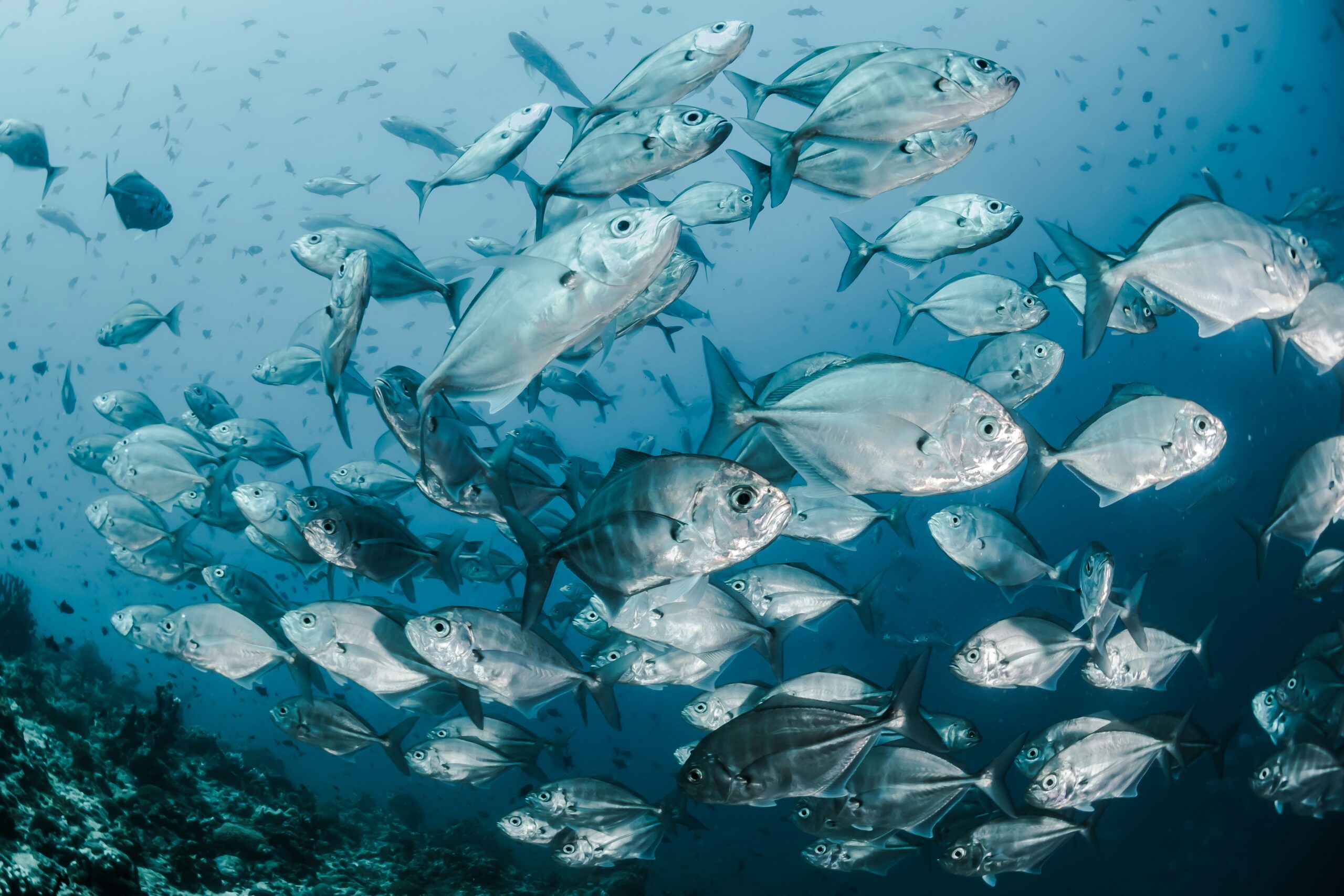
Almost 40% of the world’s population lives within 100km of a coast. Over three billion people worldwide rely on the oceans for their food security. The blue economy is now estimated to be worth over $2.6 trillion, supporting more than 130 million full-time equivalent jobs globally (World Bank).
Global aquaculture and capture fisheries represent a significant share of the blue economy, and now play a major role in feeding the world, having already surpassed aquatic animal production since 2022. Aquaculture is also responsible for all of the growth: farmed output is expected to expand roughly 2.7%, while wild catch barely moves, held back due to overfishing and strong scientific advice recommending sharp quota cuts for stocks like North Sea cod and Northeast Atlantic mackerel. As David Attenborough highlighted so effectively in his documentary Ocean, our industrial fishing practices are decimating our ocean biodiversity. There has to be another way.
Yet capital has not caught up to the opportunity: ocean-related investments still make up only around 1% of the $1.57 trillion impact-investing market, and marine ecosystems receive less than 9% of total investment in nature-based solutions. That gap, between a sector now central to feeding the planet and a sector still starved of specialist capital, is precisely the kind of inflection point that we feel is worth investigating.
To do just that, EthicalFin has recently hosted a lunch with leading sustainable aquaculture investors Aqua-Spark to explore what is changing in sustainable aquaculture, what is becoming investable at scale, and where bottlenecks still exist to deploying more capital in this market. Having personally invested in Aqua-Spark’s cooperative, I have long believed in the opportunity in this space and in Aqua-Spark’s team and approach, and as pioneers in this space they have deep insights into the state of the market.
Aqua-Spark was founded in 2013, at a time when “blue economy” was not yet a category. Fast forward to today and co-founder Amy Novogratz and Michiel Krauss made a central claim: we are moving from a decade of engineering and proof of concept into a decade of deployment. In other words, the sector is no longer defined mainly by research risk, but is increasingly defined by scaling risk, and that shift changes the investment equation. This transition is being supported by significant market demand driving the adoption of innovation, especially in the feed space (the production of alternative and improved feed ingredients for fish farming) where product-market fit has been proven.
The ocean is tapped, growth has to come from farming, not catching
One point framed the whole conversation: wild catch has been essentially flat for decades, not because effort has declined, but because we are at the biological limit in most commercially viable fisheries. Demand for protein continues to grow, and seafood remains one of the most nutrient dense and efficient options, but future supply increases cannot come from wild caught fish in the oceans. They must come from aquaculture, done properly. After several high-profile successes and failures, the sector is now poised for real sustainable growth. Aqua-Spark’s recent white paper makes the point bluntly: 100% of future seafood supply growth must come from sustainable aquaculture, and farmed seafood is already approaching 60% of global production.
This matters because it reframes aquaculture from a niche alternative into a structural pillar of food security. It also puts real pressure on the industry to solve issues that, until recently, kept many investors on the sidelines: feed inputs, disease, welfare, transparency, and the environmental footprint of production.
The uncomfortable truth: sustainability rarely sells itself, regulation does
We discussed, candidly, why certain harmful practices persist. Bottom trawling is a devastating example: ecologically destructive, politically difficult to eliminate, and commercially entrenched. A classic example of the challenges of businesses that are not forced to price their negative externalities. Amy also touched on the impact of fishmeal and fish oil supply chains, which can destroy habitats and undermine the very rationale of farming fish sustainably. The industry needs alternatives, but those alternatives must be priced competitively. Most consumers and businesses are not willing to pay a meaningful sustainability premium, at least not consistently.
This is why regulation and buyer requirements matter more than good intentions. The strongest “push” for change often comes from enforceable standards, not from voluntary commitments. Norway is a useful example in the global salmon market: regulation is moving away from crude volume limits towards performance-based systems, tying growth rights to measurable outcomes such as sea lice counts and environmental footprints.
Why 2026 feels like a turning point, four forces converging
Aqua-Spark’s view is that the inflection point is not one breakthrough, it is a convergence. Four shifts are happening at once: major buyers are mandating antibiotic free fish and traceable supply chains as a condition of procurement; regulators are rewarding performance and mandating monitoring; the research consensus has quantified the scale of the opportunity; mainstream M&A has arrived, setting valuation signals that did not exist five years ago.
This was one of the most useful parts of our session, because it moves the conversation from “interesting theme” to “what changes the adoption curve”. As procurement standards become stricter and regulation becomes more measurable, producers can no longer treat the adoption of new technologies as optional. They increasingly need them to meet buyers’ requirements, comply with regulation and remain competitive. That is when adoption accelerates and markets can scale.
The technology stack is finally maturing, and it is maturing across the whole system
Aqua-Spark’s investing is built around a systems thesis, not a single bet. In practice, that means you cannot fix aquaculture with one innovation. You need progress across the full operating stack. And their approach to both fostering the entire ecosystem and supporting their portfolio companies with business, commercial and fundraising support is testament to that, and is one of their key differentiators.
Our lunch discussion kept coming back to four practical layers, which map to Aqua-Spark’s framework:
-
Feed: replacing wild inputs at commercial scale
The industry needs credible alternatives to traditional feed ingredients, including fishmeal and soy. Insect larva based proteins are a particularly compelling pathway, and Aqua-Spark’s investment in Protix is one example of the “feed transition” in action. The point is not novelty, it is scale and cost. If alternative feed ingredients can be produced sustainably at price parity, the sector can break its dependence on finite wild fisheries and improve unit economics at the same time.
-
Farm technology: managing what you cannot see
Aquaculture is literally under water, which historically made measurement and control difficult. Monitoring is evolving rapidly with new technologies, including feeding optimisation and biomass measurement. The shift from manual estimates to camera-driven and sensor-based systems is one example. Amy gave a specific example: even basic fish counts were once handled by people trying to physically count stock. That is an extraordinary baseline. The move towards data driven farm management can unlock significant value not just in terms of efficiency, but also in terms of risk reduction.
-
Health and biological risk: prevention over cure
Sea lice in salmon farming is a concrete case of how biology becomes a financial risk. We touched on detection, prevention, and non-medicinal approaches, as well as how regulatory requirements are accelerating adoption of monitoring systems. The broader point is that disease and mortality have historically been the largest source of loss in aquaculture. When you improve survival rates and reduce antibiotic dependency, you do not just create impact, you create profit, and you unlock better commercial relationships.
-
Traceability: from premium feature to licence to operate
Digital traceability is becoming non-negotiable. The EU’s push towards fully digital seafood traceability from 2026 is part of a wider shift: regulators, retailers and institutional investors increasingly require verifiable chains of custody.
The investment lens: why specialist underwriting matters
For many investors, aquaculture has felt opaque and too much of a niche. That came up repeatedly, not as a criticism, but as a reality. Biology, operations, and regulation interact in ways that do not exist in software or conventional services. This is precisely why specialist underwriting matters. The most credible funds in the space do not just provide capital, they offer pattern recognition, governance discipline, and a network of operators. That is one of the reasons Aqua-Spark has been able to build a portfolio that spans enabling technologies and production systems, rather than making isolated bets.
We also touched on a structural shift: as portfolio companies mature, capital needs increase. That creates pressure on fundraising, but it also signals something important: that the sector is producing businesses that want to scale, and can scale, if the financing ecosystem is there.
This mirrors a broader point we have made in other parts of the transition economy: when an industry moves from experimentation to deployment, capital becomes the bottleneck, and the winners are often those who can allocate into the enabling infrastructure at the right moment.
Closing thought
The takeaway is not that aquaculture is “the next big thing”. It is more specific: we have moved past the time when sustainable aquaculture was too early, too opaque, or too small for serious capital. The solutions are becoming real, measurable, and governed by more mature regulation. The open question is: how quickly can capital be mobilised to scale the essential parts of this new sustainable system?
Disclaimer: this article is for information and discussion only. It does not constitute an offer, an invitation, or a solicitation to invest. Any sharing of investment materials or subsequent investment-related discussion would be subject to applicable investor eligibility, financial-promotion and local jurisdictional requirements. Capital is at risk and private market investments can be illiquid.
Photo credit: Sebastian Pena Lambarri
Comments are closed.

